
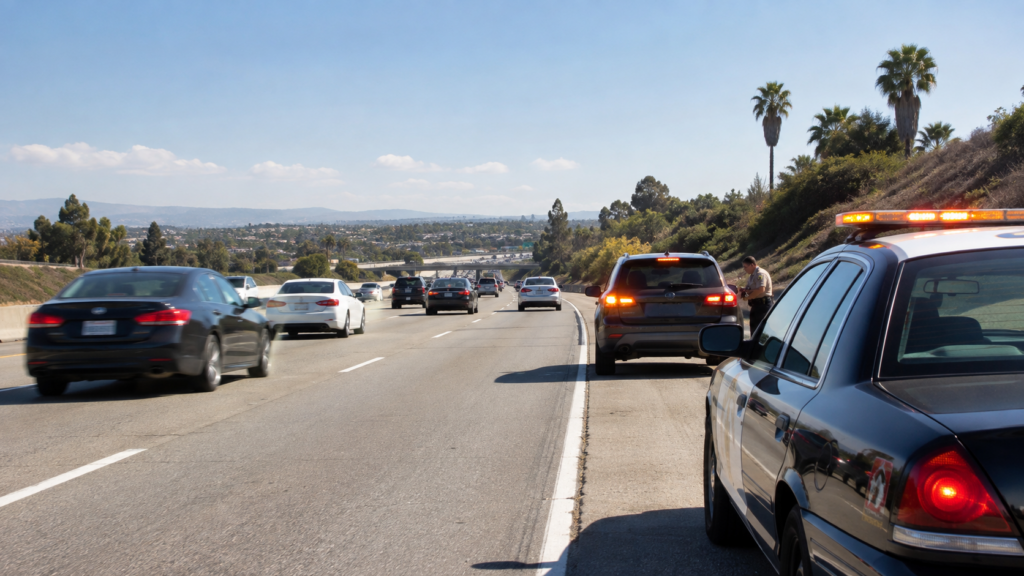
California changed its roadside safety rules in 2026 by expanding the state’s “Slow Down, Move Over” law. The change is particularly important for drivers traveling on busy highways, freeways, and urban roads where disabled vehicles, roadside workers, tow operators, and other stopped vehicles can create dangerous conditions.
Assembly Bill 390 expanded the existing law effective January 1, 2026. Under the updated rule, drivers approaching certain stationary vehicles displaying flashing hazard lights or other warning devices must move into a lane that is not immediately adjacent when it is safe and practicable to do so. If changing lanes is unsafe or impractical, the driver must slow to a reasonable and prudent speed that is safe for existing conditions.
The California Office of Traffic Safety highlighted the expanded law as an important 2026 roadside safety measure. The change matters not only for preventing crashes, but also because a violation may become relevant when investigators evaluate how a collision occurred.
What Changed Under California’s 2026 Law?
California has had a Move Over requirement for years, but the 2026 expansion broadens the circumstances in which drivers must take additional care around stopped vehicles.
According to the California Highway Patrol, AB 390 expands the law to cover stationary highway maintenance vehicles and other stationary vehicles using flashing hazard lights or warning devices such as cones and road flares.
This means motorists should not assume that the rule applies only when they see a police cruiser, ambulance, or fire truck. Depending on the circumstances, a disabled vehicle or another stopped vehicle displaying the required warning signals may also trigger the driver’s obligation to move over or slow down.
The precise circumstances matter. Drivers must consider whether a lane change is safe and practicable. If moving over cannot safely be accomplished, slowing down becomes the required alternative.
Why the Law Matters for Car Accident Claims
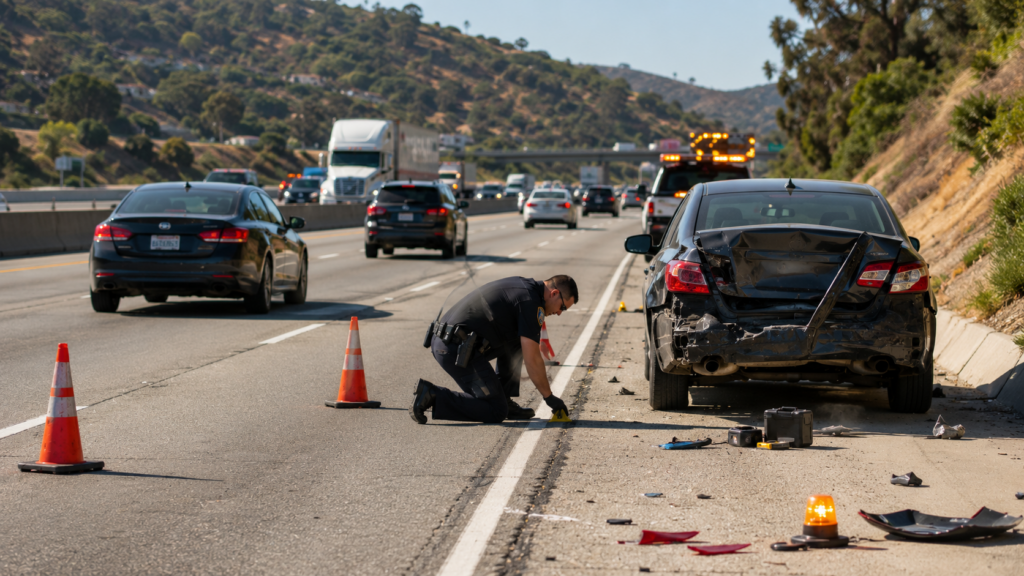
The expanded law is primarily designed to prevent roadside collisions. However, traffic laws can also become relevant when determining how a crash occurred.
Suppose a driver approaches a stopped vehicle on the shoulder but continues through the adjacent lane without reducing speed. If that driver subsequently strikes the stopped vehicle, a roadside worker, or another motorist, investigators may examine whether the driver complied with the applicable safety requirements.
A traffic-law violation does not automatically determine the outcome of a civil injury claim. Liability generally depends on the facts and evidence surrounding the collision. Still, evidence that a driver failed to follow a safety rule can be relevant when evaluating negligence.
For additional information about how fault may be evaluated in California collisions, readers can explore our liability and fault rules articles.
What Drivers Must Do When Approaching a Stopped Vehicle
The safest response begins with reducing speed and paying close attention to the roadway. When a stationary vehicle is displaying the applicable warning lights or devices, drivers should determine whether they can safely move into another lane away from the stopped vehicle.
If traffic, road construction, barriers, or other circumstances make a lane change unsafe or impractical, the driver must slow to a reasonable and prudent speed. This requires considering actual conditions rather than simply maintaining the posted speed limit.
The California DMV Driver Handbook provides broader guidance about California traffic laws, roadway conditions, traffic control devices, and safe driving responsibilities.
Drivers should also remember that changing lanes suddenly can create another hazard. A driver who moves over without checking surrounding traffic could cause a separate collision. The goal of the law is to create additional space safely, not to encourage an abrupt or dangerous maneuver.
How a Slow Down, Move Over Violation Can Become Evidence
Evidence can be especially important when a crash occurs near a disabled vehicle or roadside worker. Accident investigators may examine photographs, vehicle damage, witness accounts, police reports, roadway markings, surveillance footage, and available video recordings.
For example, photographs may show where a stopped vehicle was positioned and whether hazard lights or warning devices were visible. Dashcam footage may provide a clearer view of traffic conditions immediately before impact.
Other evidence may establish whether a driver had enough time and space to recognize the stopped vehicle and respond appropriately.
Our accident evidence articles provide additional information about the types of evidence that may be relevant after a California collision.
Roadside Workers Face Particular Risks
Roadside workers often operate close to moving traffic while performing maintenance, repairs, towing, or emergency services. Even a momentary loss of attention by a passing driver can create a serious danger.
California’s expanded law specifically recognizes the need for additional protection around stationary highway maintenance vehicles and other qualifying vehicles.
The California Office of Traffic Safety has emphasized roadside safety as part of its broader traffic-safety efforts in 2026.
For motorists, the practical lesson is straightforward: watch for warning lights, cones, flares, stopped vehicles, and people working near the roadway. Begin slowing early and make a safe lane change when possible.
What Happens If a Crash Occurs Near a Stopped Vehicle?
A collision near a stopped vehicle may involve more than two vehicles. For example, a driver could strike a disabled vehicle, causing it to move into another lane and collide with a third vehicle. A roadside worker could also be injured while assisting a stranded motorist.
These circumstances can make determining responsibility more complicated. Investigators may need to establish the position and movement of each vehicle, the timing of the collision, roadway conditions, visibility, traffic volume, and the actions of each driver.
The Caltrans QuickMap can also provide current and historical roadway-related information such as traffic conditions, lane closures, incidents, and other highway information, although the availability of historical information for a particular crash should not be assumed.
Could Dashcam Footage Help?
Dashcams can be particularly useful in roadside collision investigations because they may capture the moments immediately before an impact. A recording could potentially show whether a stopped vehicle had hazard lights activated, whether warning devices were visible, how traffic was moving, and whether another driver attempted to change lanes.
Modern vehicles may also contain additional electronic information. Depending on the vehicle and circumstances, available data can include information related to speed, braking, steering, or other vehicle functions.
However, not every vehicle records the same information, and the existence of electronic data does not necessarily mean that the information will be available or prove liability. Preserving relevant evidence quickly can be important.
How Fault May Be Evaluated After a Roadside Crash
California uses a comparative negligence system. This means that responsibility for a collision may potentially be divided among multiple parties based on their respective contributions to the accident.
In a roadside collision, investigators might examine the actions of the approaching driver as well as the conduct and position of other motorists. Road design, visibility, traffic conditions, mechanical problems, and the circumstances surrounding the stopped vehicle may also be relevant.
For example, if a driver claims that there was no opportunity to change lanes, evidence showing heavy traffic or a physical barrier could become important. Conversely, evidence showing an open adjacent lane and a clearly visible stopped vehicle could provide a different picture.
This is why simply identifying a traffic violation does not necessarily answer every liability question. The complete circumstances surrounding the crash should be evaluated.
What Injured Drivers Should Do After a Roadside Collision
If you are involved in a collision near a stopped vehicle, your first priority should be safety. Move to a safe location when possible and seek emergency medical assistance if anyone is injured.
Contact law enforcement when appropriate and provide an accurate account of what happened. Avoid making assumptions about fault at the scene. Instead, document what you can safely observe.
Photograph vehicle damage, roadway conditions, traffic signs, lane markings, warning devices, and the position of the vehicles when it is safe to do so.
Preserve dashcam footage rather than allowing the recording to be overwritten. If other people witnessed the crash, obtain their contact information when possible.
You can also review our car accident news and articles for additional information about collisions and accident-related issues.
What If the Other Driver Was Speeding?
Speed can become particularly important when a driver approaches a roadside incident. A vehicle traveling too quickly may have less time to recognize a stopped vehicle and less distance available to slow or move over safely.
Speed can also affect the severity of a collision. The National Highway Traffic Safety Administration identifies speeding as a major traffic safety issue and explains how excessive speed can increase both crash risk and crash severity.
If speeding and failure to move over are both alleged, investigators may need to consider how those factors interacted with the circumstances of the collision.
What If Someone Is Injured While Helping at the Roadside?
Roadside crashes can involve people who were not originally involved in the first incident. A person may stop to assist another motorist, a tow operator may arrive to remove a disabled vehicle, or a highway worker may be performing maintenance.
When a secondary collision occurs, the legal issues can become complicated. The people involved, the vehicles present, and the sequence of events may all need to be identified.
California’s expanded roadside safety rule is intended to reduce these dangers by requiring drivers to create more space or reduce speed around qualifying stopped vehicles.
Why Preserving Evidence Matters
Roadside accident evidence can disappear quickly. Vehicles are moved, debris is cleared, warning devices are removed, and traffic conditions change.
Photographs and video captured soon after a collision may therefore provide important context. Police reports, witness information, vehicle damage, and available camera footage can also help reconstruct what happened.
Drivers should avoid deleting potentially relevant recordings or altering photographs. Original files can be more useful than edited versions because they may preserve metadata and the complete sequence of events.
For more information about accident documentation, visit our Accident Evidence category.
How the 2026 Law May Affect Insurance Claims
Insurance companies investigate accidents using the available evidence and the circumstances surrounding the collision. If an accident occurred near a stopped vehicle, an insurer may examine whether the approaching driver slowed down, moved over, or had a reasonable opportunity to avoid the collision.
A traffic citation can be relevant to an investigation, but an insurance determination and a civil court’s determination of liability are not necessarily identical. The evidence should be considered as a whole.
Maintaining medical records, photographs, repair documentation, witness information, and other relevant records can help establish the circumstances and consequences of an accident.
Newport Beach Drivers Should Pay Attention to the Change
Although AB 390 is a statewide California law, it is relevant to drivers throughout Newport Beach and Orange County. Local roads can become crowded with commuters, visitors, delivery vehicles, cyclists, pedestrians, and motorists entering and leaving busy commercial areas.
A disabled vehicle on the shoulder or a roadside service vehicle stopped near moving traffic can create a sudden hazard. Drivers should remain alert and be prepared to reduce speed or safely change lanes.
The California Office of Traffic Safety provides additional traffic safety information and public education resources for California motorists.
Understanding the Law After a Crash
California’s expanded Slow Down, Move Over law is intended to protect people working on or stranded beside the roadway. For drivers, the rule creates a clear safety expectation: when approaching a qualifying stationary vehicle, move away from it when doing so is safe and practicable, or slow to a reasonable and prudent speed when changing lanes is not possible.
For accident victims, the law may also become relevant when investigating how a collision occurred. Evidence concerning vehicle positions, warning lights, traffic conditions, speed, lane availability, and driver behavior can help establish the circumstances surrounding a crash.
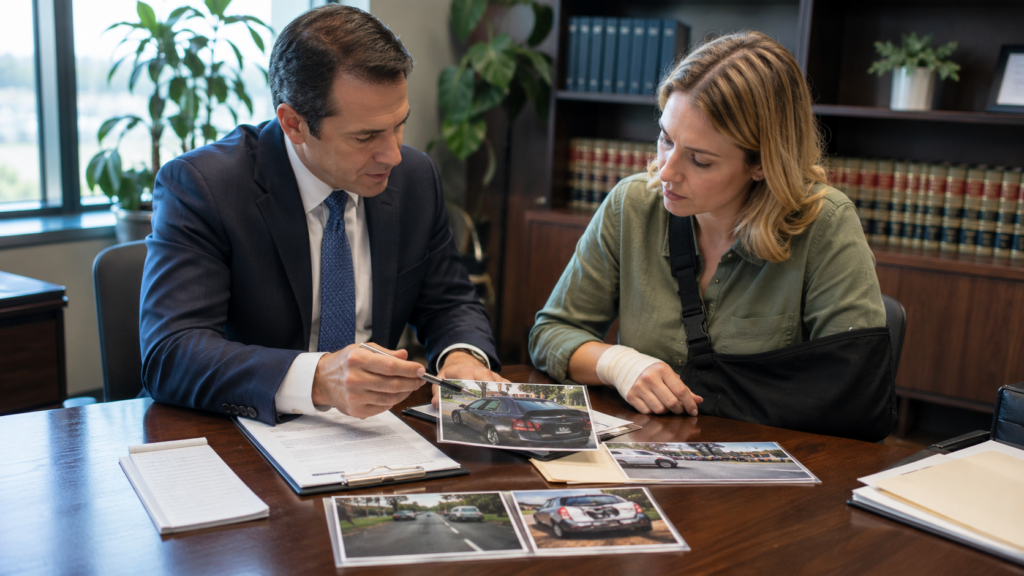
If you were injured in a collision involving a stopped vehicle or roadside worker, understanding the applicable traffic rules and preserving available evidence may be important to your claim. Review our California car accident law articles for additional information about accident claims and legal issues.
Final Thoughts
The 2026 expansion of California’s Slow Down, Move Over law reflects a broader effort to make roads safer for emergency responders, highway workers, tow operators, stranded motorists, and passengers. The law now covers a broader range of stationary vehicles displaying the required warning lights or devices.
For Newport Beach drivers, the safest approach is to remain alert, recognize roadside warning signals early, create additional space whenever it is safe to do so, and reduce speed when changing lanes is not practical.
If a collision occurs, preserve available evidence and obtain appropriate medical and law-enforcement assistance. When liability is disputed, evidence showing what each driver could see and how each driver responded may become especially important.
For additional information about California personal injury issues following a crash, visit our Personal Injury category.